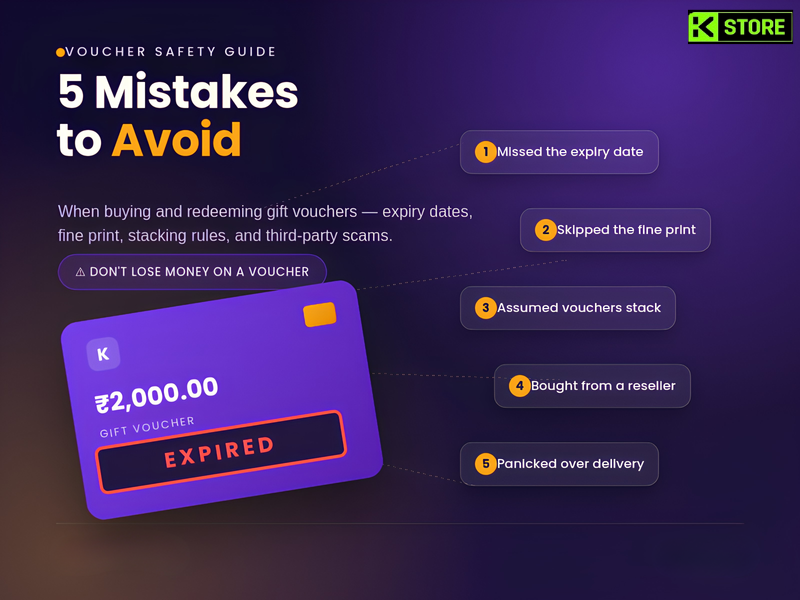
Gift vouchers feel like free money. You buy one, you save a little, you redeem it, everyone’s happy. Except when they’re not , when the code doesn’t work, the balance vanishes, or you realize three months too late that your ₹2,000 voucher expired while you were “saving it for something special.”
None of this is complicated once you know what to check. Here are the five mistakes people make most often when buying and redeeming gift vouchers, and how to actually avoid them.
Mistake 01: Not Checking the Expiry Date Before You Buy
This is the single most common way people lose money on vouchers. You buy it, tuck it away “for later,” and later turns into six months, and six months turns into “wait, is this thing even still valid?”
Most vouchers do carry an expiry date, and once that date passes, the balance is usually gone for good , no extensions, no partial refunds, no exceptions. Some platforms are upfront about this at the point of purchase; others bury it in a follow-up email you’ll skim and forget.
How to avoid it: Check the expiry before you buy, not after. On KStore, voucher terms , including expiry, if the voucher has one , are laid out on the product page itself, and the confirmation email you get after purchase also spells out the expiry and redemption details in writing. If you’re buying a voucher to use immediately, this barely matters. If you’re stockpiling vouchers for later, it matters a lot , set a reminder on your phone the day you buy it, not the day before it expires.
Mistake 02: Skipping the Terms & Conditions
Nobody reads the T&Cs. That’s not a guess, that’s just how gift vouchers get “misused” in the first place. People assume a voucher works everywhere, on everything, for everyone , and then get surprised when it doesn’t.
The details that actually matter and that people skip:
- Region locks , some vouchers only work in specific countries, and using one meant for a different region simply won’t redeem.
- Category restrictions , a fashion voucher might not apply to sale items, or a food voucher might exclude certain outlets.
- Minimum order values , some vouchers require you to spend above a threshold before the code applies.
- Single-use vs. reloadable , most vouchers are one-time use; assuming you can redeem it in parts when you can’t is a common, avoidable disappointment.
How to avoid it: Read the voucher description before purchase, not after checkout fails. KStore tags region-specific vouchers clearly , anything marked “Global” can be redeemed anywhere, and anything without that tag is restricted to specific countries, so you know before you buy rather than after you’re stuck with a code that doesn’t work where you are.
Mistake 03: Assuming You Can Stack Vouchers Freely
“I’ll just use three ₹500 vouchers to pay for one ₹1,500 order” sounds reasonable until the brand’s own rules say otherwise. A lot of retailers cap how many vouchers can be applied to a single transaction , sometimes it’s one voucher per order, sometimes it’s a set maximum, and sometimes stacking isn’t allowed at all.
This is a brand-side rule, not a voucher-platform rule, which is exactly why it trips people up , the voucher itself doesn’t warn you at the point of purchase, only at checkout on the retailer’s site, by which point you’ve already planned your order around an assumption that wasn’t true.
How to avoid it: Before you buy multiple vouchers for the same order, check the redeeming brand’s own gift card policy; most retailers publish a “maximum vouchers per order” rule on their own help pages. If you’re buying through KStore, you can purchase multiple vouchers in a single order without issue on the platform’s end; the stacking limit you need to worry about is whatever the brand you’re redeeming with allows.
Mistake 04: Buying From Unverified Third-Party Sellers
This is the one that actually costs people real money, not just a missed discount. Discounted gift vouchers circulate in some genuinely sketchy corners of the internet , random resale groups, unofficial marketplaces, “too good to be true” listings on classifieds sites. Common outcomes: the code is already used, it’s a duplicate, it was never valid, or the “seller” disappears the moment payment clears.
The tell-tale signs of a scam listing are consistent: no verifiable platform behind the sale, no order history, no customer support to contact if something goes wrong, and discounts that are wildly out of line with what legitimate platforms offer (nobody is selling a genuine ₹5,000 voucher for ₹2,000 out of the goodness of their heart).
How to avoid it: Buy vouchers only from platforms that have an actual order-tracking and support system behind them. On KStore, every purchase triggers two confirmation emails , one for the purchase itself, one with the voucher code and redemption details , and you can check order status any time under your Profile’s Order History. If a voucher isn’t delivered properly, the platform’s policy is to resend the code or issue a refund rather than leave you stuck. That kind of accountability is exactly what a random third-party reseller can’t offer you.
Mistake 05: Not Verifying Delivery Before Assuming It Failed
The flip side of mistake 04: sometimes a voucher purchase is completely legitimate, but people panic when the code doesn’t land in their inbox within thirty seconds, assume they’ve been scammed, and either dispute the payment unnecessarily or give up on a voucher that was on its way the whole time.
Digital delivery isn’t always instant. Processing can occasionally take longer than expected , rare, but it happens , and treating a short delay as proof of a scam causes more stress than the situation warrants.
How to avoid it: Give it a reasonable window before assuming something’s wrong. On KStore, order status shows as “Completed” once the code has been emailed, “Processing” if it’s still on its way (which can occasionally take up to 24 hours in rare cases), or “Partially Completed” if only part of a multi-voucher order went through , in which case you’re refunded for whatever wasn’t delivered. Checking your Order History tells you exactly where things stand instead of guessing.
The Pattern Behind All Five Mistakes
Look at these five again and the common thread is obvious: almost every voucher mistake comes down to not checking something before you paid, rather than the voucher itself being defective. Expiry, terms, stacking rules, seller legitimacy, delivery status , all of it is information that exists and is checkable, just usually after it’s too late to matter.
The fix isn’t complicated. Buy from a platform that actually shows you the terms upfront, tags region restrictions clearly, keeps an order history you can check, and has a real process for resends and refunds when something goes wrong , rather than a marketplace listing with no accountability behind it. That’s the difference between a gift voucher that quietly saves you money and one that quietly costs you money you’ll only notice later.
Buying vouchers for your next purchase? Check the terms, note the expiry, and buy from a platform like KStore that shows you all of it upfront , not a listing that disappears the moment something goes wrong.


