Creating a cryptocurrency token used to sound like a job that required a blockchain developer, a smart-contract engineer, and a fair amount of technical patience.
In 2026, that is no longer necessarily the case.
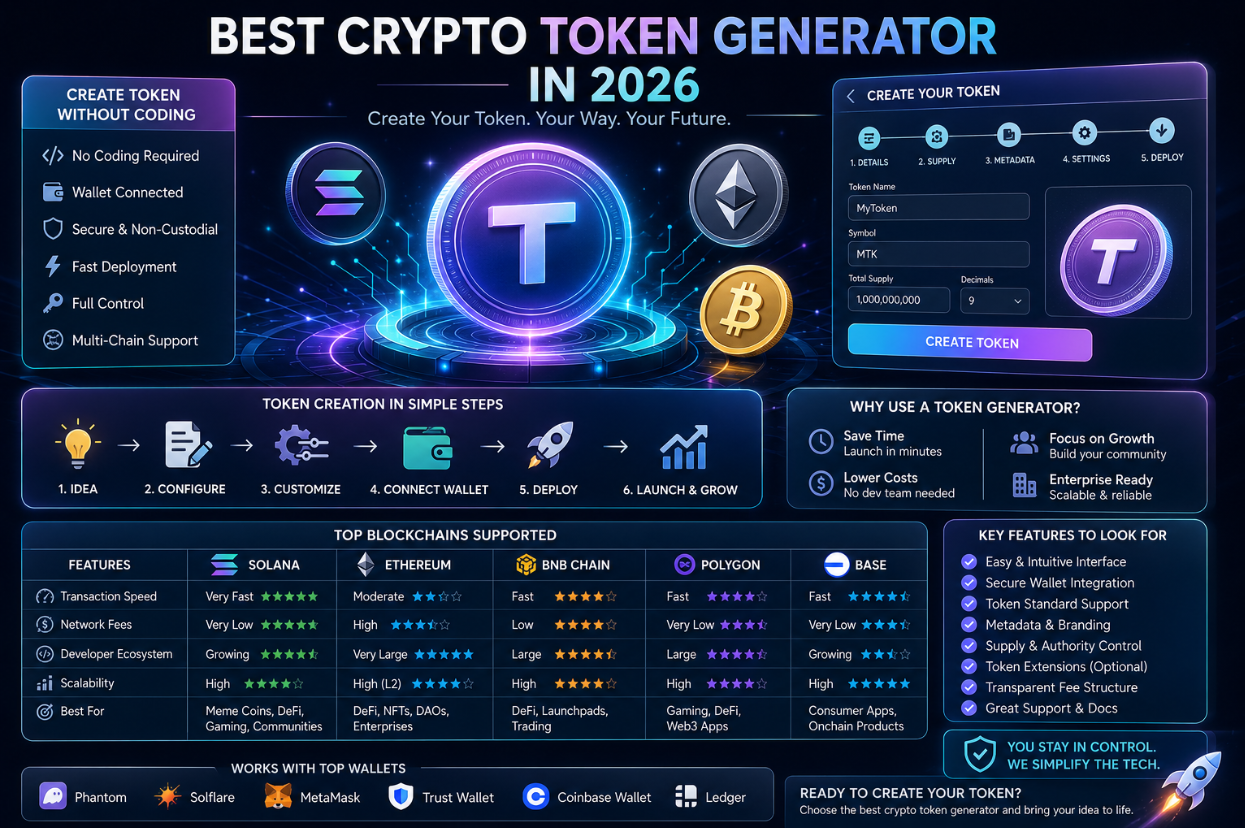
Modern crypto token generators allow founders, creators, marketers, communities, and developers to configure and deploy tokens through a visual interface. Instead of writing every blockchain instruction manually, you can often enter your token details, connect a wallet, review the transaction, and deploy.
But there is an important distinction between making a token and building a successful token project.
A token generator can help you create the asset. It cannot automatically give that asset utility, liquidity, a community, sustainable tokenomics, or market demand.
That is why choosing the right token generator matters.
This guide explains what a crypto token generator actually does, how the major approaches compare, what features to look for in 2026, and how to choose a platform based on your project rather than marketing claims.
What Is a Crypto Token Generator?
A crypto token generator is a tool that simplifies the process of creating a blockchain-based token.
Instead of manually interacting with blockchain programs or writing a smart contract from scratch, the generator provides a user interface where you configure the token.
Depending on the blockchain and platform, you may be able to define:
- Token name
- Token symbol
- Total supply
- Decimal precision
- Token image
- Description
- Website
- Social links
- Minting permissions
- Freeze permissions
- Metadata
- Token extensions
- Other token-specific settings
After configuration, the platform typically prepares the required blockchain transaction or transactions. Your wallet then signs them.
The result is an actual blockchain asset.
On Solana, for example, the token mint contains important information such as supply, decimals, mint authority, and freeze authority. Solana’s documentation also covers operations such as minting, transferring, burning and changing token authorities. (Solana)
Why Use a Crypto Token Generator Instead of Coding?
The biggest advantage is accessibility.
Suppose you want to create a community token on Solana.
The traditional development route could involve:
- Setting up development tools
- Installing blockchain libraries
- Creating a mint
- Configuring authorities
- Creating token accounts
- Minting supply
- Configuring metadata
- Testing transactions
- Managing deployment
A no-code generator turns many of these technical operations into a guided workflow.
Traditional approach
Developer → Code → Test → Deploy → Verify
No-code approach
Creator → Configure → Review → Sign → Deploy
That difference is particularly useful for founders who understand their business or community idea but don’t necessarily want to become blockchain programmers.
The Best Crypto Token Generator Depends on Your Blockchain
There is no universal token standard.
This is one of the first things you should understand before selecting a generator.
Different ecosystems use different token architectures.
| Blockchain Ecosystem | Common Token Standard / Model | Typical Use |
| Solana | SPL Token / Token-2022 | Fungible tokens, DeFi, communities, applications |
| Ethereum | ERC-20 | DeFi, governance, utility tokens |
| BNB Chain | BEP-20 | EVM-based tokens |
| Polygon | ERC-20 | Applications and token ecosystems |
| Base | ERC-20 | EVM applications and consumer crypto |
| Arbitrum | ERC-20 | DeFi and Ethereum-compatible applications |
Ethereum’s ERC-20 standard defines common functions such as transfer, approve, transferFrom, balanceOf, and totalSupply. OpenZeppelin provides widely used ERC-20 implementations and extensions for developers. (OpenZeppelin Docs)
Solana uses a different architecture based around token programs and accounts.
So a token generator designed specifically for Solana isn’t simply an Ethereum token generator with a different logo.
Solana vs Ethereum Token Creation
For many new projects, the decision comes down to the ecosystem they want to build in.
Solana
Solana provides the SPL Token Program and Token Extensions Program.
Token-2022 allows additional functionality through extensions. Solana’s documentation notes that many extensions need to be initialized when the mint or token account is created, and some extensions are incompatible with one another. (Solana)
Ethereum
Ethereum uses smart contracts for token standards such as ERC-20.
The advantage is an enormous developer and application ecosystem, with established tooling such as OpenZeppelin’s reusable contract libraries. (OpenZeppelin Docs)
Neither approach is automatically “better.”
The right choice depends on your project.
What Makes a Good Crypto Token Generator?
A good token generator isn’t simply the one with the biggest “Create Token” button.
Look for these characteristics.
1. Simple User Interface
A beginner should be able to understand what each setting does.
If a platform asks you to configure:
Mint Authority
Freeze Authority
Decimals
Metadata URI
without explaining them, the interface isn’t doing enough.
A good generator should reduce complexity without hiding important decisions.
2. Wallet-Based Transactions
Security should be one of your first considerations.
A non-custodial token creation workflow should allow you to connect your wallet and approve transactions yourself.
You should never provide your seed phrase or private key to a token generator.
Your wallet should remain under your control.
On Solana, token operations are executed through on-chain programs, while your wallet authorizes transactions. Solana’s documentation specifically describes authority management as part of the token lifecycle. (Solana)
3. Token Supply Controls
Supply is one of the most important decisions you’ll make.
Imagine two projects:
Project A
Total supply:
1,000,000 tokens
Fixed supply.
Project B
Total supply:
1,000,000 tokens
But the creator retains permission to mint additional tokens.
Those two projects may look identical at launch.
They are not.
For public tokens, supply permissions can significantly affect how users perceive the project.
A token generator should therefore make supply and minting permissions easy to understand.
4. Authority Management
On Solana, authority settings deserve particular attention.
The main concepts include:
Mint Authority
Controls whether additional tokens can be minted.
Freeze Authority
Can freeze token accounts under the applicable token program.
Update Authority
Can control whether associated metadata remains changeable, depending on the metadata system and configuration.
Solana’s token documentation describes mint and freeze authority as part of the mint configuration and provides instructions for changing or revoking authorities. (Solana)
A quality token generator should expose these decisions rather than burying them.
5. Metadata Support
A token without recognizable metadata can create a poor user experience.
You may want:
- Logo
- Name
- Symbol
- Description
- Website
- X/Twitter
- Telegram
- Discord
Metadata helps wallets, explorers and applications present the token correctly.
For Solana projects, metadata can be associated with the token through established ecosystem tooling such as Metaplex.
This is particularly important for community and meme tokens where visual identity is part of the project’s brand.
6. Token-2022 Support
For Solana projects that need advanced token functionality, Token-2022 deserves attention.
Solana describes Token Extensions as optional features that can be applied to token mints or accounts. Examples include transfer fees, non-transferability and other specialized behavior. (Solana)
However, don’t select Token-2022 simply because it sounds newer.
The better question is:
Do I actually need an extension?
If you’re launching a basic fungible token, a standard SPL token may be sufficient.
If you need advanced functionality, Token-2022 may be worth evaluating.
7. Transparent Pricing
Token generators use different pricing models.
Some charge a fixed platform fee.
Others charge according to the features you select.
Some may bundle token creation with other services.
When comparing platforms, calculate the total deployment cost, including:
- Platform fee
- Blockchain transaction costs
- Metadata costs
- Authority changes
- Liquidity setup
- Optional services
Don’t choose a platform solely because its homepage advertises a low starting price.
8. Documentation
This is an underrated feature.
A token generator should explain what happens when you click Create.
Good documentation should answer:
- Which blockchain program is used?
- What token standard is created?
- Who owns the token?
- Can supply increase later?
- Can accounts be frozen?
- Can metadata change?
- What wallet is required?
- What fees are involved?
- What happens after deployment?
If you can’t find these answers, slow down before signing.
Crypto Token Generator vs Smart Contract Development
A no-code generator isn’t always the right solution.
Here’s the basic difference.
| Feature | Token Generator | Custom Development |
| Coding required | Usually no | Yes |
| Deployment speed | Fast | Slower |
| Custom logic | Limited | Extensive |
| Beginner friendly | High | Low |
| Token configuration | Standardized | Fully customizable |
| Smart-contract/program logic | Limited | Full control |
| Development cost | Lower | Higher |
| Best for | Standard token launches | Complex applications |
A token generator is similar to using a website builder instead of writing a web framework from scratch.
You sacrifice some flexibility in exchange for speed and simplicity.
Best Crypto Token Generator for Different Types of Users
Rather than asking “Which token generator is number one?”, ask:
Which token generator is best for my use case?
For Beginners
Choose a platform with:
- Simple interface
- Clear explanations
- Wallet connection
- Transparent pricing
- Basic token configuration
- Good documentation
You shouldn’t need to understand Rust or Solidity just to create a basic token.
For Solana Meme Coin Creators
Look for:
- SPL token support
- Metadata
- Custom supply
- Authority controls
- Wallet integration
- Optional liquidity tools
- Solana ecosystem compatibility
Speed matters, but don’t sacrifice control just to save a few clicks.
For DeFi Projects
You may need more than a basic token creator.
Consider:
- Token-2022 extensions
- Custom programs
- Governance
- Staking
- Treasury management
- Automated distributions
- Liquidity infrastructure
A no-code creator may be useful for the token itself, but complex DeFi logic usually requires additional development.
For Developers
Developers may prefer:
- SDKs
- CLI tools
- Open-source libraries
- Smart-contract frameworks
- Direct blockchain APIs
Thirdweb, for example, provides tools for deploying ERC-20 contracts and modular contract components, while OpenZeppelin provides reusable ERC-20 implementations and extensions for Ethereum-based development. (thirdweb docs)
The advantage is maximum control.
The downside is a much higher technical barrier.
Popular Approaches to Crypto Token Creation
There are several major approaches available in 2026.
No-Code Token Creators
These are designed for founders and creators who want to deploy standard tokens without programming.
Best for: Beginners, communities, startups and simple launches.
Multi-Chain Token Platforms
These allow users to create tokens across several networks from a common interface.
Best for: Teams working across multiple ecosystems.
The tradeoff is that chain-specific functionality may vary.
Developer Platforms
Platforms such as thirdweb provide contract deployment workflows and development tooling. Its documentation includes an ERC-20 Core deployment workflow where users select contract metadata and a chain before deploying. (thirdweb docs)
Best for: Developers and technical teams.
Direct Blockchain Development
Experienced developers can interact directly with the relevant blockchain programs and frameworks.
Best for: Custom protocols and advanced applications.
This provides the greatest flexibility but requires significantly more technical knowledge.
Why “One-Click Token Creation” Can Be Misleading
Creating the token may take a few clicks.
Launching the project properly doesn’t.
Think about a real-world example.
Suppose you create:
100 million ABC tokens
The token exists.
But then what?
You still need to decide:
- Who receives the tokens?
- How much does the team hold?
- Is there a liquidity pool?
- What is the initial price?
- How is liquidity funded?
- Is mint authority retained?
- How will users discover the project?
- Does the token have utility?
- How will treasury funds be managed?
The token generator solves one part of the problem.
It doesn’t solve the entire project.
Token Creation vs Token Launch
These terms are often used interchangeably, but they shouldn’t be.
Token Creation
Creates the blockchain asset.
Token Launch
Introduces that asset to users and markets.
A launch may involve:
- Liquidity
- Distribution
- Community building
- Marketing
- DEX availability
- Token allocation
- Market monitoring
This distinction is critical.
You can create a token without launching it.
Token Creation vs Liquidity
Another common misconception is:
“Once my token is created, people can trade it.”
Not necessarily.
A token can exist on-chain without having meaningful market liquidity.
For decentralized trading, you generally need a trading venue and appropriate liquidity.
That is why serious token planning usually looks more like:
Create Token → Configure Metadata → Distribute → Add Liquidity → Launch → Monitor
rather than:
Create Token → Done
Liquidity Is Not the Same as Volume
This distinction is especially important for new projects.
Liquidity
The assets available to facilitate buying and selling.
Trading Volume
The value of transactions taking place during a particular period.
A token can have:
- High liquidity but low volume
- High volume but relatively shallow liquidity
- Low liquidity and low volume
They measure different things.
If you’re creating a token, don’t use trading volume as a substitute for liquidity.
Common Mistakes When Using a Token Generator
Mistake 1: Choosing the Wrong Blockchain
Don’t choose a token creator first.
Choose your ecosystem first.
Mistake 2: Copying Someone Else’s Tokenomics
A billion-token supply might make sense for one project and be completely unnecessary for another.
Token supply should follow your distribution model and utility.
Mistake 3: Ignoring Decimals
Decimals determine how divisible your token is.
For example, a token with 6 decimals can represent smaller units than one with 0 decimals.
The appropriate value depends on the use case and token standard.
Mistake 4: Forgetting About Authorities
Before launch, understand who can:
- Mint
- Freeze
- Update
- Manage
A token with unexpected administrative permissions can create unnecessary trust concerns.
Mistake 5: Assuming Metadata Is Permanent
If metadata remains updateable, someone with the relevant authority may be able to change it.
If you want immutable metadata, understand the implications before revoking the relevant authority.
Mistake 6: Sending Your Seed Phrase
Never give your seed phrase or private key to a token creation website.
A token generator should not need control of your wallet.
Mistake 7: Creating the Token Before Planning Distribution
You should know where the initial supply is going before you mint it.
A Practical Token Generator Workflow
A modern no-code token creation process typically looks like this:
Step 1: Choose Your Blockchain
For example:
Solana
or
Ethereum
Step 2: Select the Token Standard
For Solana, this could mean choosing between the original Token Program and Token-2022 depending on requirements.
For Ethereum, ERC-20 is the common fungible-token standard. (OpenZeppelin Docs)
Step 3: Define Token Details
Set:
- Name
- Symbol
- Supply
- Decimals
Step 4: Add Metadata
Configure:
- Logo
- Description
- Website
- Social links
Step 5: Review Permissions
Check:
- Mint authority
- Freeze authority
- Update authority
Step 6: Connect Your Wallet
Make sure you are using the correct wallet.
Step 7: Review the Transaction
Don’t blindly approve.
Step 8: Deploy
Sign the transaction.
Step 9: Verify On-Chain
Check the resulting token address and configuration using an appropriate blockchain explorer.
How IDX Solana Fits Into the Token Generator Landscape
For creators specifically building on Solana, IDX Solana’s Token Creator is one example of a specialized no-code workflow.
The tool allows creators to configure an SPL token including its name, symbol, decimals, supply, description, image, social links and selected authority options before creating it through a connected wallet. (IDX Launchlab)
Create a Solana Token with IDX
The advantage of using a Solana-specific tool is that the workflow is designed around the Solana token ecosystem rather than trying to make every blockchain look identical.
IDX also documents a token creation flow covering wallet connection, token parameters, metadata and authority configuration. (IDX Solana Documentation)
For creators building a standard Solana token, that can make the process considerably easier than working directly from the command line.
What Happens After You Create the Token?
This is where the real work begins.
A sensible project lifecycle might look like:
1. Token Creation
↓
2. Metadata Configuration
↓
3. Authority Review
↓
4. Token Distribution
↓
5. Liquidity Setup
↓
6. DEX Availability
↓
7. Community Growth
↓
8. Monitoring
A token generator handles the first stage and potentially parts of the second and third.
The rest requires a broader launch strategy.
Developer Note: Plan the Architecture Before Deployment
Developers should avoid choosing token standards based purely on convenience.
Consider:
- Required functionality
- Wallet compatibility
- DEX compatibility
- Application integrations
- Transfer behavior
- Authority requirements
- Future upgrade requirements
This is especially important with Solana Token-2022.
Solana states that most extensions cannot be added after the relevant mint or account has already been initialized, and some extensions are incompatible with one another. (Solana)
That means:
Token architecture is a design decision, not a cosmetic setting.
Investor Note: The Generator Doesn’t Determine the Quality of a Token
If you’re evaluating a cryptocurrency, don’t assume a sophisticated-looking token generator means the project itself is sophisticated.
Instead, investigate the actual token.
Look at:
- Mint address
- Supply
- Holder distribution
- Liquidity
- Authorities
- Token standard
- Team allocation
- Treasury
- Utility
- Contract/program behavior
- Community
The tool used to create the token is only one small piece of the story.
Myth vs Reality
| Myth | Reality |
| Creating a token means creating a cryptocurrency ecosystem | A token is only one component of an ecosystem |
| No-code means risk-free | No-code removes coding complexity, not project risk |
| More supply means higher potential | Supply alone does not determine value |
| Token creation automatically creates liquidity | Liquidity is a separate process |
| Renouncing authority makes every token safe | It removes certain administrative powers but doesn’t guarantee project quality |
| Every token creator works the same way | Token standards and implementations vary |
| The cheapest token generator is the best | Features, security and transparency matter too |
| A token is automatically listed everywhere after creation | Wallets, DEXs and trackers have their own requirements |
How to Choose the Best Crypto Token Generator in 2026
Use this checklist before committing to a platform.
Blockchain
Does it support the network you actually want?
Token Standard
Does it create the correct native token type?
Security
Are transactions signed through your wallet?
Control
Can you understand and manage token authorities?
Metadata
Can you configure your project’s identity properly?
Cost
Can you see the complete cost before signing?
Documentation
Does the platform explain what you’re creating?
Compatibility
Will the resulting token work with the applications and infrastructure you need?
Post-Launch Tools
Does the platform provide useful tools for liquidity, distribution or management?
This last category can be valuable because token creation rarely happens in isolation.
Frequently Asked Questions
1. What is the best crypto token generator in 2026?
There isn’t one token generator that is best for every project. The best choice depends on your blockchain, token standard, required features, security requirements, budget and technical expertise.
2. Can I create a crypto token without coding?
Yes. No-code token generators allow users to configure and deploy many standard blockchain tokens without manually writing smart-contract or blockchain code.
3. What is the best token generator for Solana?
For a Solana project, a Solana-focused token generator can be useful because its workflow can be built around SPL tokens, Solana wallets, metadata and Solana-specific authority management.
4. What is the difference between a token generator and a smart contract?
A token generator is a user-facing tool that simplifies token deployment. A smart contract is blockchain code that defines behavior on networks such as Ethereum. On Solana, token functionality is provided through token programs rather than the same contract model used by Ethereum.
5. How much does it cost to create a crypto token?
The cost varies by blockchain and platform. You may pay blockchain transaction costs, platform fees and optional feature fees. Always check the complete cost before approving deployment.
6. Can I create a Solana token without being a developer?
Yes. A no-code Solana token creator can handle many of the technical deployment steps through a wallet-connected interface.
7. What is the difference between SPL Token and Token-2022?
Both are Solana token programs. Token-2022 adds optional extensions that can provide additional functionality beyond the original Token Program. Solana notes that many extensions must be planned at initialization and that some combinations are incompatible. (Solana)
8. Can I change my token supply after creating it?
It depends on the token’s authority configuration. On Solana, the mint authority controls minting additional tokens. If that authority is revoked, that authority can no longer mint additional supply. (Solana)
9. Does creating a token automatically create a liquidity pool?
No. Token creation and liquidity provision are separate operations.
10. Is a no-code token generator safe?
A no-code platform can simplify deployment, but safety depends on the platform, wallet practices, token configuration and the transactions you approve. Never share private keys or seed phrases.
11. Can I create an ERC-20 token without coding?
Some platforms provide visual or guided ERC-20 deployment workflows. Developers can also use established libraries such as OpenZeppelin to implement ERC-20 contracts. (OpenZeppelin Docs)
12. Should I use a token generator for a DeFi project?
It depends on the project’s complexity. A generator can be suitable for the basic token, but advanced DeFi functionality such as staking, governance, automated market mechanisms or complex permissions may require custom development.
Key Takeaways
- A crypto token generator simplifies blockchain token deployment.
- The best generator depends on your blockchain and project requirements.
- Solana and Ethereum use different token architectures.
- Solana supports the original Token Program and Token-2022.
- Token-2022 provides additional functionality through extensions, but those features should be planned before deployment. (Solana)
- Supply, decimals and authority settings are important token-design decisions.
- Never give a token generator your private key or seed phrase.
- Metadata is an important part of a professional token launch.
- Token creation is not the same thing as token launching.
- Creating a token does not automatically create liquidity or market demand.
- No-code tools reduce development complexity but don’t remove financial, technical or regulatory risks.
- Custom development remains the better option for projects requiring complex blockchain logic.
- For Solana creators who want a straightforward no-code workflow, a specialized tool such as the IDX Launchlab can simplify the deployment process. (IDX Solana)
Conclusion
The best crypto token generator in 2026 isn’t necessarily the platform with the most features, the lowest advertised price, or the biggest marketing campaign.
It is the platform that gives you the right combination of simplicity, control, transparency, security and blockchain compatibility for your specific project.
If you’re creating a basic community token, a no-code generator can eliminate a significant amount of unnecessary technical work.
If you’re building a sophisticated DeFi protocol, gaming ecosystem or financial application, you’ll probably need more than a token generator.
The most important thing is to think beyond the creation button.
Before deploying, know:
What are you creating?
Why does it need a token?
Which blockchain should it use?
How will supply work?
Who controls the authorities?
How will users acquire it?
Where will liquidity come from?
What happens after launch?
Once those questions have good answers, the actual token creation process becomes much easier.
For Solana builders ready to move from planning to deployment, you can create your Solana token with IDX and configure the core token parameters through a wallet-connected, no-code workflow. (IDX Solana)


