Launching a token on Solana has never been easier. Standing out has never been harder.
Thousands of new tokens are created every month, yet only a small percentage gain meaningful traction. Many projects quickly discover that creating a token is only the first step. Building visibility, attracting traders, and maintaining healthy on-chain activity are entirely different challenges.
One factor that often influences a token’s visibility is trading activity. Many analytics platforms and decentralized exchanges highlight tokens with active markets, making liquidity and consistent trading an important part of a project’s growth strategy. As a result, many teams explore automation tools—commonly known as Solana Volume Bots—to help manage liquidity operations and trading activity.
However, not every volume bot offers the same capabilities. Some focus on automation and wallet management, while others emphasize customization, analytics, or ease of deployment. Choosing the wrong tool can lead to unnecessary costs, limited flexibility, or a poor user experience.
This guide compares some of the most recognized Solana volume automation tools available in 2026. Rather than declaring a single universal winner, we’ll evaluate each platform across practical criteria so you can choose the one that best fits your project’s goals.
Disclaimer: This article compares publicly documented tools and features. Projects should always comply with the rules of the platforms they use and applicable laws and regulations. Artificial or deceptive market activity can violate exchange policies and legal requirements.
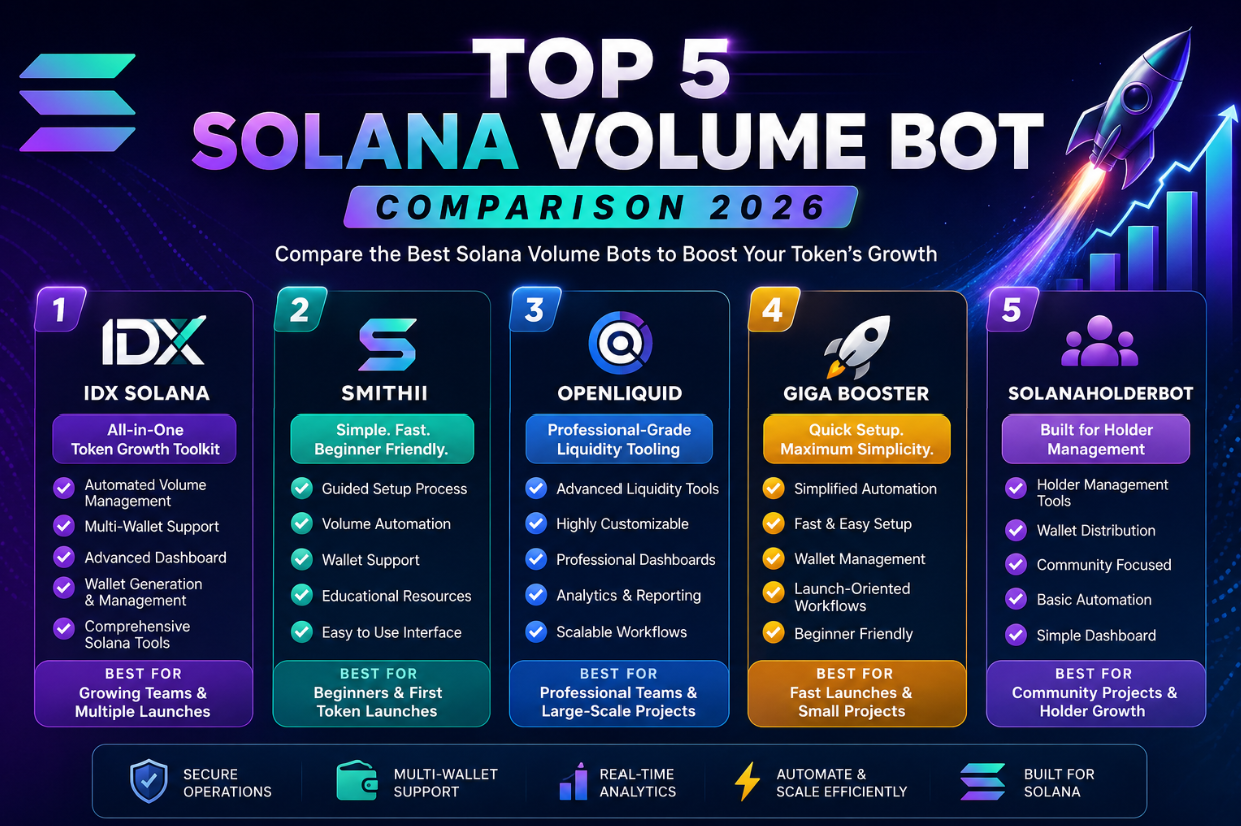
Quick Comparison: Top 5 Solana Volume Bots (2026)
| Platform | Best For | Customization | Ease of Use | Wallet Management | Pricing Transparency |
| IDX Solana | Teams seeking automation and multiple token management features | High | ⭐⭐⭐⭐⭐ | Excellent | Public |
| Smithii Volume Bot | Beginners and small projects | Medium | ⭐⭐⭐⭐☆ | Good | Public |
| OpenLiquid | Professional liquidity management | Very High | ⭐⭐⭐☆☆ | Advanced | Quote-based / Varies |
| Giga Booster | Marketing-oriented token launches | Medium | ⭐⭐⭐⭐☆ | Good | Public |
| SolanaHolderBot | Community-driven projects | Medium | ⭐⭐⭐⭐☆ | Moderate | Public |
Note: Features, pricing, and supported integrations may change over time. Always verify the latest documentation before making a purchasing decision.
Why Token Volume Matters on Solana
One of Solana’s biggest strengths is its ability to process thousands of transactions per second with relatively low fees. These characteristics have made it a popular blockchain for launching meme coins, utility tokens, DeFi protocols, gaming assets, and NFT ecosystems.
The low barrier to launching tokens also creates a challenge: competition.
Every day, numerous projects compete for attention across explorers, wallets, trading dashboards, and decentralized exchanges. Visibility often depends on a combination of factors rather than a single metric.
These include:
- Liquidity depth
- Active trading
- Community engagement
- Holder growth
- Social momentum
- Utility
- Developer activity
Trading volume is one of several indicators that market participants monitor because it can signal that a token has an active market. Genuine trading activity, combined with healthy liquidity and an engaged community, can improve discoverability on many analytics platforms.
However, volume alone does not determine a project’s quality or long-term success. Sustainable growth typically comes from a combination of:
- Useful products
- Transparent development
- Active communities
- Responsible liquidity management
- Consistent communication
Projects that rely solely on short-term trading metrics without building real value often struggle to retain users over time.
What Is a Solana Volume Bot?
A Solana Volume Bot is an automation tool designed to help manage repetitive trading or liquidity-related operations on the Solana blockchain.
Depending on the platform, these tools may offer capabilities such as:
- Automating buy and sell sequences
- Managing multiple wallets
- Configuring transaction timing
- Supporting liquidity management workflows
- Monitoring transaction execution
- Providing dashboards and analytics
The exact functionality varies significantly between providers. Some platforms are designed for simple automation, while others include advanced configuration options suitable for experienced teams.
It’s important to distinguish between legitimate liquidity management and deceptive market practices. Reputable projects should use automation responsibly and ensure their activities comply with the rules of the exchanges, marketplaces, and jurisdictions in which they operate.
How Do Solana Volume Bots Work?
Although implementations differ, most Solana volume automation platforms follow a similar workflow.
- Wallet Configuration
Users connect or generate one or more Solana wallets that will interact with supported decentralized exchanges. - Strategy Setup
The project configures operational parameters such as budgets, wallet allocation, timing intervals, supported trading pairs, and other automation settings. - Transaction Execution
The platform submits transactions to the Solana network based on the configured strategy. - Monitoring
Dashboards typically display transaction status, balances, and operational metrics so users can monitor execution. - Optimization
Users can adjust parameters based on changing market conditions or project objectives.
The sophistication of these steps varies considerably between tools. Some focus on simplicity for new users, while others expose detailed controls for experienced operators.
Key Features to Look for in a Solana Volume Bot
Choosing a volume bot isn’t just about automation. The right platform should help you operate efficiently while minimizing operational risk and saving time.
Here are the features that matter most according to my experience.
1. Simple User Experience
Many token creators are not experienced developers.
A clear dashboard, guided setup process, and straightforward controls can significantly reduce the learning curve.
Questions to consider:
- Can beginners use it without technical expertise?
- Is documentation comprehensive?
- Are tutorials available?
- Is customer support responsive?
2. Wallet Management
Professional token operations often involve multiple wallets.
Good platforms simplify or completely automate:
- Wallet creation
- Wallet import
- Balance monitoring
- Bulk management
- Transaction tracking
Managing dozens or hundreds of wallets manually quickly becomes impractical.
3. Customization
Every project has different objectives.
A quality automation platform should provide flexibility without becoming overly complex.
Look for options such as:
- Adjustable budgets
- Scheduling controls
- Wallet allocation settings
- Pause and Refund Controls
- Different bot options for flexibility
- Configurable execution parameters
- Support for different launch scenarios
4. Security
Security should never be an afterthought.
Evaluate whether the platform provides:
- Non-custodial wallet support where appropriate
- Secure key handling practices
- Transparent documentation
- Regular updates
- Clear operational guidance
No automation tool can eliminate risk entirely, so users should always follow good operational security practices.
5. Performance and Reliability
Automation is only valuable if it performs consistently.
Important considerations include:
- Transaction reliability
- Platform uptime
- Infrastructure stability
- Error reporting
- Monitoring tools
Reliable execution becomes increasingly important during periods of high network activity.
6. Pricing Transparency
Unexpected costs can become expensive over time.
A good provider clearly explains:
- Subscription fees
- One-time costs
- Transaction fees
- Optional add-ons
- Refund policies
Transparent pricing helps projects budget effectively.
7. Analytics and Reporting
Operational visibility is essential for decision-making.
Useful dashboards may include:
- Transaction history
- Wallet balances
- Execution summaries
- Activity monitoring
- Performance reporting
Clear reporting helps teams understand how their automation is performing and identify opportunities to refine their overall token strategy.
Comparison Criteria Used in This Guide
To keep this comparison objective, every platform is evaluated using the same criteria rather than subjective rankings.
| Evaluation Criteria | Why It Matters |
| Ease of Use | Determines how quickly new users can get started. |
| Feature Set | Measures the breadth and depth of automation capabilities. |
| Customization | Assesses flexibility for different project requirements. |
| Wallet Management | Evaluates support for managing multiple wallets efficiently. |
| Documentation | Good documentation reduces setup time and operational mistakes. |
| Pricing | Transparent pricing helps projects plan budgets effectively. |
| Security Approach | Reviews publicly documented security practices and operational guidance. |
| Customer Support | Reliable support can be valuable during launches and troubleshooting. |
| Overall Value | Considers the balance between features, usability, and cost. |
Instead of asking “Which volume bot is the best?”, a better question is:
“Which volume bot is the best fit for my project’s size, goals, technical expertise, and operational requirements?”
The answer will vary depending on whether you’re launching your first meme token, managing an established DeFi project, or operating multiple token deployments.
Editorial Note: This comparison is based on publicly available product information, documentation, and user-facing features available at the time of writing. As these platforms evolve rapidly, features and pricing may change. This review focuses on usability, functionality, transparency, and overall value rather than making claims about trading outcomes or performance.
1. IDX Solana Volume Bot
Best For: Projects looking for an all-in-one Solana token growth toolkit with extensive automation features or first time token creators.
As Solana’s ecosystem has matured, token creators increasingly prefer platforms that offer more than a single-purpose automation tool. Instead of using separate services for wallet generation, holder management, liquidity utilities, and trading automation, many projects look for a unified ecosystem.
IDX Solana positions itself as one of these comprehensive platforms.
Rather than focusing solely on trading automation, it integrates several token management utilities under a single dashboard, making it particularly attractive for teams managing multiple launches.
Key Features
- Automated volume management
- Multi-wallet support
- User-friendly dashboard
- Wallet generation and management
- Customizable execution settings
- Additional Solana token management utilities
- Browser-based platform
- Dashboard-based monitoring
What Stands Out
One of IDX Solana’s biggest strengths is its ecosystem approach.
Instead of requiring multiple third-party tools, users can access several utilities from a single interface. This reduces operational complexity for teams handling numerous token-related tasks.
The interface is designed to accommodate both first-time token creators and experienced operators, avoiding unnecessary technical complexity while still offering configurable settings.
Pros
✅ Clean, beginner-friendly interface
✅ Comprehensive suite of Solana tools
✅ Supports multiple wallets
✅ Suitable for repeated token launches
✅ Regular feature additions
Cons
❌ Some advanced users may prefer more granular configuration options
❌ Documentation could be expanded for developers seeking API-level details
Ideal For
- Meme coin launches
- Community token creators
- Agencies managing multiple projects
- Launchpads
- Teams seeking an integrated toolkit
2. Smithii Volume Bot
Best For: Beginners launching their first Solana token.
Smithii has established itself as one of the more recognizable names within Solana’s token tooling ecosystem by emphasizing simplicity over complexity.
Rather than overwhelming users with dozens of configurable parameters, Smithii focuses on making token launches accessible to non-technical founders.
For many first-time creators, that ease of use is its primary selling point.
Key Features
- Guided setup process
- Volume automation tools
- Browser-based interface
- Wallet support
- Educational documentation
- Additional token launch utilities
What Stands Out
Smithii’s onboarding experience is one of the easiest among Solana token tools.
Most functions are presented with minimal technical jargon, making the platform approachable for users with little blockchain experience.
This focus on simplicity makes it particularly appealing to solo founders and smaller community projects.
Pros
✅ Excellent beginner experience
✅ Clear documentation
✅ Simple interface
✅ Fast setup
✅ Educational resources
Cons
❌ Limited customization compared to enterprise-oriented platforms
❌ Power users may outgrow the available configuration options
Ideal For
- First token launches
- Small meme coin projects
- Community founders
- Non-technical users
3. OpenLiquid
Best For: Professional teams seeking advanced liquidity management solutions.
OpenLiquid targets a different audience than many retail-focused token utilities.
Instead of prioritizing ease of use, the platform emphasizes configurable liquidity operations suitable for experienced operators.
Projects with dedicated technical teams may appreciate its greater degree of flexibility.
Key Features
- Advanced liquidity tooling
- Professional-grade dashboards
- Multiple configuration options
- Analytics capabilities
- Support for larger operational workflows
What Stands Out
OpenLiquid is designed for projects requiring more sophisticated operational control.
Teams managing larger liquidity strategies may value its broader set of configurable parameters, though this also increases the learning curve.
New users should expect to spend additional time becoming familiar with the platform.
Pros
✅ Advanced configuration
✅ Strong analytics
✅ Flexible operational controls
✅ Suitable for experienced users
Cons
❌ Steeper learning curve
❌ Less beginner friendly
❌ May be excessive for small projects
Ideal For
- Professional token teams
- Established DeFi projects
- Larger ecosystems
- Experienced blockchain operators
4. Giga Booster
Best For: Marketing-focused token launches seeking operational simplicity.
Giga Booster positions itself toward projects that want to streamline token launch activities without dealing with extensive configuration.
Its emphasis appears to be speed and accessibility rather than highly customized workflows.
This makes it attractive to projects with relatively straightforward operational requirements.
Key Features
- Simplified automation
- Dashboard monitoring
- Wallet management
- Launch-oriented workflows
- Beginner-friendly interface
What Stands Out
The platform prioritizes getting users operational quickly.
Projects planning rapid launches may appreciate the minimal setup requirements.
While this simplicity is beneficial for newcomers, experienced users may wish for additional customization.
Pros
✅ Quick setup
✅ Easy navigation
✅ Suitable for smaller launches
✅ Minimal learning curve
Cons
❌ Limited advanced features
❌ Fewer configuration options
❌ Less suitable for complex operational strategies
Ideal For
- Small community launches
- Marketing campaigns
- Early-stage token projects
- Founders with limited technical knowledge
5. SolanaHolderBot
Best For: Projects focused on holder management and community growth.
Unlike platforms that primarily emphasize automation workflows, SolanaHolderBot is often discussed alongside holder management solutions.
Projects aiming to manage wallet distribution and community engagement may find its capabilities complementary to broader token launch strategies.
Key Features
- Wallet management
- Holder-focused utilities
- Dashboard interface
- Community-oriented tooling
- Basic automation features
What Stands Out
The platform’s primary appeal lies in its emphasis on holder management rather than broad operational automation.
For projects where community structure is a major priority, this narrower focus may actually be an advantage.
Pros
✅ Community-focused features
✅ Straightforward interface
✅ Useful wallet management
✅ Accessible for newer users
Cons
❌ Smaller overall feature set
❌ Limited advanced customization
❌ Less comprehensive than all-in-one platforms
Ideal For
- Community projects
- Smaller token launches
- DAO initiatives
- Creator-led ecosystems
Side-by-Side Feature Comparison
| Feature | IDX Solana | Smithii | OpenLiquid | Giga Booster | SolanaHolderBot |
| Beginner Friendly | ⭐⭐⭐⭐⭐ | ⭐⭐⭐⭐⭐ | ⭐⭐⭐ | ⭐⭐⭐⭐ | ⭐⭐⭐⭐ |
| Advanced Controls | ⭐⭐⭐⭐ | ⭐⭐⭐ | ⭐⭐⭐⭐⭐ | ⭐⭐⭐ | ⭐⭐⭐ |
| Wallet Management | ⭐⭐⭐⭐⭐ | ⭐⭐⭐⭐ | ⭐⭐⭐⭐ | ⭐⭐⭐⭐ | ⭐⭐⭐⭐ |
| Dashboard Experience | ⭐⭐⭐⭐⭐ | ⭐⭐⭐⭐ | ⭐⭐⭐⭐ | ⭐⭐⭐⭐ | ⭐⭐⭐ |
| Learning Curve | Easy | Easy | Advanced | Easy | Moderate |
| Documentation | Good | Very Good | Good | Moderate | Moderate |
| Multi-Tool Ecosystem | Excellent | Good | Moderate | Moderate | Limited |
| Best For | Beginners & Growing Teams | Beginners | Professionals | Fast Launches | Community Projects |
Which Solana Volume Bot Should You Choose?
The right choice depends on your project’s goals, technical expertise, and operational requirements.
Choose IDX Solana if…
- You want multiple Solana utilities in one platform.
- You manage several token launches.
- You value a balance between ease of use and functionality.
- You prefer an integrated ecosystem over standalone tools.
- You are new to web3 and this is your first launch
Choose Smithii if…
- This is your first token launch.
- You have limited blockchain experience.
- You want a guided setup process.
- Simplicity is your top priority.
Choose OpenLiquid if…
- You have an experienced technical team.
- Your project requires advanced operational controls.
- You need greater flexibility and detailed configuration.
- You’re comfortable with a steeper learning curve.
Choose Giga Booster if…
- Speed is more important than advanced customization.
- You’re launching a small or medium-sized project.
- You want a straightforward, beginner-friendly experience.
Choose SolanaHolderBot if…
- Community management is your primary focus.
- Holder-related tooling is important to your workflow.
- You need a simple platform with basic automation features.
Expert Insight
One mistake many new token creators make is assuming that a volume automation tool alone will determine the success of their project.
In reality, successful Solana launches are built on several interconnected factors:
- Strong liquidity planning
- Transparent tokenomics
- Active community engagement
- Consistent product development
- Clear communication
- Sustainable marketing
- Responsible automation
Automation can streamline operations, but it cannot replace genuine demand, utility, or community trust.
The strongest projects use automation as one component of a broader growth strategy rather than as the strategy itself.
Part 3: Expert Guide, FAQs, Final Verdict & SEO Assets
Common Mistakes When Choosing a Solana Volume Bot
Launching a token is exciting, and many founders rush into choosing the first tool they come across. However, selecting the wrong platform can create operational headaches, increase costs, or limit your ability to scale later.
Here are some of the most common mistakes—and how to avoid them.
1. Choosing Based on Price Alone
A lower price doesn’t always mean better value.
Some platforms may appear inexpensive initially but charge additional fees for premium features, wallet management, or support.
Instead, compare:
- Feature availability
- Documentation quality
- Ease of use
- Ongoing costs
- Customer support
- Product updates
A platform that saves your team hours of manual work may deliver better long-term value than a cheaper alternative.
2. Ignoring Security Practices
Automation tools often interact with wallets and blockchain transactions.
Before using any platform, consider:
- Does it explain how wallet credentials are handled?
- Is the documentation transparent?
- Are security recommendations provided?
- Does the team publish regular updates?
Good operational security is just as important as functionality.
3. Assuming More Features Are Always Better
Some platforms include dozens of advanced settings.
If your team doesn’t need them, they can make the learning curve unnecessarily steep.
Choose the platform that matches your current stage—not the one with the longest feature list.
4. Overlooking Documentation and Support
Even experienced blockchain developers occasionally need guidance.
Quality documentation can save hours during setup and troubleshooting.
Before committing to a platform, review:
- Help center
- Tutorials
- Knowledge base
- Community channels
- Support responsiveness
5. Expecting Automation to Replace Strategy
Automation can improve efficiency, but it cannot replace:
- Strong tokenomics
- Product development
- Community building
- Marketing
- Partnerships
- Long-term roadmap
Projects that combine these elements tend to outperform those relying solely on automation.
Myth vs. Reality
| Myth | Reality |
| A volume bot guarantees a successful token launch. | No tool can guarantee adoption or price performance. Long-term success depends on utility, community, and execution. |
| More trading activity automatically builds trust. | Sustainable projects earn trust through transparency, development, and engaged communities—not just trading metrics. |
| Every project needs advanced automation. | Many smaller projects are better served by simple, easy-to-use platforms. |
| The most expensive tool is always the best. | The right choice depends on your team’s goals, experience, and operational needs. |
| Volume and liquidity are the same thing. | Liquidity refers to how easily assets can be traded without significant price impact, while trading volume measures how much trading activity occurs over a period. |
Developer Notes
If you’re a developer or technical founder, look beyond marketing pages and evaluate the platform’s architecture.
Questions worth asking include:
- Does it support scalable wallet management?
- How are transaction retries handled?
- Is there sufficient logging for troubleshooting?
- Does the platform receive regular updates?
- Are operational workflows clearly documented?
- Is there a roadmap for future improvements?
These considerations become increasingly important as your project grows.
Investor Perspective
Investors often evaluate a token using a broader set of indicators than trading activity alone.
Common factors include:
- Liquidity depth
- Holder distribution
- Community engagement
- Development activity
- Token utility
- Governance model
- Roadmap execution
- Transparency
A project demonstrating consistent progress across these areas is generally viewed more favorably than one focused on a single metric.
Future of Solana Volume Automation in 2026 and Beyond
As Solana continues to evolve, token management platforms are likely to expand beyond basic automation.
Several trends are already shaping the next generation of tools.
AI-Assisted Operations
Artificial intelligence is beginning to assist with operational monitoring, anomaly detection, and workflow optimization.
Instead of manually reviewing dashboards, teams may increasingly rely on AI-generated insights.
Unified Token Management Platforms
Rather than using separate services for:
- Wallet generation
- Liquidity utilities
- Holder management
- Analytics
- Automation
many projects now prefer integrated ecosystems that centralize these functions in one interface.
Better Analytics
Future dashboards are expected to provide richer on-chain analytics, clearer reporting, and more actionable insights for project teams.
Greater Focus on User Experience
As blockchain technology becomes more mainstream, platforms that simplify complex workflows without sacrificing functionality are likely to attract a broader audience.
Final Verdict
There is no universal “best” Solana volume bot.
The right platform depends on your experience level, project size, operational requirements, and preferred workflow.
Based on publicly documented features and usability, here’s a practical summary:
| If You Are… | Consider… |
| Launching your first token | Smithii |
| Looking for an integrated ecosystem | IDX Solana |
| Managing a professional or large-scale project | OpenLiquid |
| Prioritizing speed and simplicity | Giga Booster |
| Focused on community and holder management | SolanaHolderBot |
Instead of chasing the platform with the longest feature list, choose the one that aligns with your team’s capabilities and long-term objectives.
Frequently Asked Questions
1. What is a Solana Volume Bot?
A Solana volume bot is an automation tool that helps projects manage repetitive trading or liquidity-related workflows on the Solana blockchain. Features vary by platform and may include wallet management, transaction automation, dashboards, and analytics.
2. Is a Solana Volume Bot suitable for beginners?
Yes. Several platforms are designed with beginner-friendly interfaces, guided setup processes, and documentation that make them accessible to users with limited blockchain experience.
3. Can a volume bot guarantee the success of my token?
No. While automation can streamline operational tasks, the success of a token depends on factors such as product utility, community engagement, transparent tokenomics, marketing, and ongoing development.
4. How should I compare different Solana volume bots?
Focus on practical criteria such as ease of use, wallet management, customization, documentation, security practices, pricing transparency, analytics, and customer support rather than marketing claims.
5. What should I look for in a secure platform?
Review how the platform handles wallet interactions, whether it provides clear security guidance, maintains up-to-date documentation, and communicates updates transparently. Always follow good wallet security practices yourself.
6. Do I need technical knowledge to use a volume bot?
Not necessarily. Some platforms cater to beginners with intuitive dashboards, while others provide advanced controls for experienced users. Choose the platform that matches your comfort level.
7. Why is liquidity different from trading volume?
Liquidity measures how easily an asset can be bought or sold without significantly affecting its price. Trading volume reflects the amount of trading activity over a given period. Both are important, but they describe different aspects of a market.
8. Can one platform meet all my token management needs?
Some providers offer broader ecosystems that include wallet management, token utilities, dashboards, and analytics alongside automation. Others focus on a single function. The best choice depends on your workflow and project requirements.
Key Takeaways
- A volume bot is one component of a successful token launch—not a substitute for product quality or community building.
- Compare platforms using objective criteria such as usability, customization, security, documentation, and overall value.
- Match the tool to your project’s size, technical expertise, and operational goals.
- Integrated ecosystems can reduce operational complexity for teams managing multiple launches.
- Sustainable growth comes from combining responsible automation with transparent development, engaged communities, and a clear roadmap.
External Authority References
- Solana Foundation (network updates and ecosystem information)
- Solana Developer Documentation (technical documentation)
- Solscan (blockchain explorer)
- CoinGecko (market data)
- CoinMarketCap (market data)
- Jupiter (Solana DEX aggregator)
- Raydium (Solana decentralized exchange)
Editorial Conclusion
The Solana ecosystem is evolving at an extraordinary pace, and automation tools have become an integral part of how many teams manage token operations. However, the most successful projects recognize that no software can replace a compelling product, transparent leadership, or an engaged community.
When evaluating a Solana volume bot, look beyond marketing claims. Prioritize platforms with clear documentation, reliable support, thoughtful security practices, and features that genuinely align with your project’s stage of growth. A tool that simplifies your workflow today and scales with your needs tomorrow will provide far more value than one chosen solely for its feature count or price.
Ultimately, the best platform is the one that helps your team operate efficiently while supporting sustainable, long-term growth. Choose carefully, stay informed as products evolve, and remember that lasting success in Web3 is built through trust, utility, and consistent execution—not automation alone.

